If your answer is more time, world peace or true love, well, mine too. But I don’t think I can do a whole lot to get them, so I have a few other ideas for gifts that might do a tiny bit of good in this world. Since I’d almost prefer being run over by a Hummer (at least it’s quick) to having to brave the mall on a Saturday, I’ve come up with a different list. This is a tough Christmas for a lot of people, and an awful lot of businesses, too, and I’d like to see people who put out a creative and useful product stay afloat.
My first suggestion is, shop locally. No, I don’t mean your local Ann Taylor or Coldwater Creek (okay, please shop at Coldwater Creek—I have stock in them and it stinks lately), I mean creative, single store merchants that have a personal vision and are selling something unique—the individual clothing shop, the local antiques merchant, the floral or plant store. People that own and run these stores are doing it as much for love as money, and they’ll be willing to talk over your problem giftees and help you come up with something. Shop there before all individuality is eaten alive by mega-corporation homogenization.
Second idea is, how about donating to a charity that has a nifty premium for a gift? National Wildlife Federation has a lot of adorable plushies and great magazines for adults and kids. Ditto World Wildlife Fund, Sierra Club, Audubon, Defenders of Wildlife, etc. I admit I don’t get a real gift thrill out of just making a donation, but these organizations have figured out that it’s a lot more fun if you have something to wrap up, or a nifty magazine.
While we’re on the subject of magazines, most of them are struggling. You can find a magazine for nearly anyone on your list—New Moon is terrific for tweens, and Carus publications has a ton for different age brackets (literary, social sciences and science). For adults, too—go to your local (preferably independent) bookseller, look through the racks and racks, pick one out, mail one of the hundreds of blown-in subscription cards and wrap up the sample. Me, I love Somerset Studio, Belle Armoire, Threads, The Washington Monthly, Marie-Claire Idées, Poets & Writers, Piano, and an armload of others (hint, hint).
A more unusual variation of the magazine gift is the literary journal subscription. In my book these have some distinct advantages: they don’t publish as frequently, hence they don’t remind me of the kind of machine that keeps spitting tennis balls at you, and I don’t add to my six foot bedside stack; and they’re smaller and you can stuff them in a pocket or purse more easily. Ones that I really like or have liked in the past include Alimentum, Granta, Glimmer Train, The Believer, and The Sun. I’ll be reviewing these in more depth one of these days.
If you’re really broke and live near a major city, I have three ideas. Do a search of second hand stores and library used book sales. The stuff at second hand stores can be unbelievable—recent finds include an Irish fisherman handknit sweater for $5, a sequined top for $1 and a Kenneth Cole dress for $5. Call it “vintage” not used and add instant chic. The Nikipedia is the queen of finds, but it really just takes a little browsing, particularly if you can find one that specializes in upscale second hand. Library book sales are amazing—it just makes me heartsick to see books for which I’ve paid $29.95 (still unread) going for $1. A lot of libraries in our area have permanent for-sale shelves or even for-sale rooms. You can come up with a nice armload of mysteries or historicals or biographies, wrap it in a big box and give a huge present for $10, while helping the library. Cheaper than the fines some of us pay, ahem.
Those same libraries, or nearby universities, have concert series for no or very low cost. How about making up a schedule and buying tickets, or designing some fake ones and provide the transportation and companionship to go with them. Me, I’d be delighted to have a friend make a commitment to attend a free series with me—so often I don’t go if I don’t have someone to go with me. And wouldn’t it be fun to have a regular “date” with a friend to do such a fun thing? Or if you’re going to purchase tickets for someone, how about favoring small theater groups, new music or early music ensembles, or student performances? These people can really use support in building an audience, and you’ll be giving something a lot more original than a gift card to the local megaplex.
Finally, don’t buy jewelry as gifts until you check out your local crafts fair or bead store. To my intense aggravation when I’m a seller, people at craft fairs often price jewelry ridiculously low, and have said to me that they just want to get their materials costs back so they can make some more. Grrrgh, but it’s great if you’re the buyer. Also, if you have the slightest jewelry making skills, at a bead store you can put together a nice gemstone bead necklace (often with loaner tools on the premises and the help of the owner) for a fraction of the department store cost. One of the bead stores in my town used to display pictures from the Sundance catalog next to nearly identical beads that you could use to make your own for about 25% of the cost. Also, take a look at the stuff on Etsy.com. My New Year’s resolution is to put stuff in my own “store” there, but in the meantime, there’s plenty of nifty things to buy, all made by highly creative kitchen table entrepreneurs.
Now, do I get an award as Santa’s little helper?
Showing posts with label Art. Show all posts
Showing posts with label Art. Show all posts
Tuesday, December 1, 2009


Tuesday, November 24, 2009
It’s a living
It ain’t easy making a living as any kind of artist. I wish I had a signed contract for every time I’ve heard a parent tell me, “Oh, my kid is so creative [fill in artist, actor, writer, dancer, whatever] but I’m telling him or her to major in [physics, accounting, chemistry, education—whatever the parent thinks is “practical”] because, of course, you can’t make a living at it.”
Well, the truth is, you can and this is dumb advice. Tons of people make a living every day at these professions, and there are plenty of out-of-work computer science majors. But, the employment path is fairly clear for computer science or chemistry: get the degree and get someone to hire you. The path for the arts is not: get the degree (or maybe not), get someone to hire you (or maybe not), sell your services, get a day gig (or maybe not)…but just because it’s not clear doesn’t make it un-doable. What does it require? Well, duh, it requires CREATIVITY.
If you want to eat and be any kind of artist, you need to think outside the box, not only with your art, but with your marketing, packaging, and bill paying. Maybe you will need to cobble together several jobs, sell several different versions of what you do, find a non-demanding dumb job (plenty of novelists have worked for the customs house, or the post office, or waiting tables) so you can still think and are raring to go when you get home.
But what these parents don’t tell their kids, what actually would be worthwhile advice, is that if you want to live by art, you'd better minor in business or plan to teach at some level. Acquiring the acumen to run a business, market, set up your website and social networking blitz—they’re all essential or no one is ever going to hear about your art.
Just like dating. It’s unlikely that anyone is ever going to arrive on a white horse. And if they do, it’s because you already have the door open and are looking out for the whinnying.
Two good books about making a living in one of the arts (writing):
Well, the truth is, you can and this is dumb advice. Tons of people make a living every day at these professions, and there are plenty of out-of-work computer science majors. But, the employment path is fairly clear for computer science or chemistry: get the degree and get someone to hire you. The path for the arts is not: get the degree (or maybe not), get someone to hire you (or maybe not), sell your services, get a day gig (or maybe not)…but just because it’s not clear doesn’t make it un-doable. What does it require? Well, duh, it requires CREATIVITY.
If you want to eat and be any kind of artist, you need to think outside the box, not only with your art, but with your marketing, packaging, and bill paying. Maybe you will need to cobble together several jobs, sell several different versions of what you do, find a non-demanding dumb job (plenty of novelists have worked for the customs house, or the post office, or waiting tables) so you can still think and are raring to go when you get home.
But what these parents don’t tell their kids, what actually would be worthwhile advice, is that if you want to live by art, you'd better minor in business or plan to teach at some level. Acquiring the acumen to run a business, market, set up your website and social networking blitz—they’re all essential or no one is ever going to hear about your art.
Just like dating. It’s unlikely that anyone is ever going to arrive on a white horse. And if they do, it’s because you already have the door open and are looking out for the whinnying.
Two good books about making a living in one of the arts (writing):
Friday, September 18, 2009
Jewelry: art, craft, whatever
I must be stuck on jewelry making this week, because I keep coming across ideas that reel me in. I’m so taken with the artistry that is put into craft these days that I often wonder why we even bother to make a distinction between craft and art. Well, sure, I can tell the difference between a crocheted toilet paper cover and the Mona Lisa, but I also see a lot of jewelry and artwear that easily belongs in a frame.
I like gems and precious metals as well as the next rapacious female, but I tend to like big and bold. (As an aside, can someone tell me why huge ladies seem to love teensy gold chains just long enough to let the charm dangle on top of their amazing shelves? Like mom used to say, a peanut on a watermelon.) Anyway, I’m not little and I like jewelry that can be seen across the room. It’s supposed to attract attention, right? So far no one has offered to give me rocks the size of Liz Taylor’s, and I wouldn’t have any place to wear them anyway, so I go for “unusual”.
I’ve just mentioned steampunk, and am really looking forward to Jean Campbell’s upcoming book on it, but in the meantime, I’ve been really intrigued by books showing how to make jewelry from hardware. There are plenty of instructions out there on using hardware, paper, or various recycled materials. Nicole Sherman's got a great one on mixing industrial with beads and precious metals, and there's another one (link below) that is more "purist" in just using hardware--and it comes with a spiral binding so you can actually follow the instructions rather than wrestling the book. After spending a lot of time being awestruck by these folks’ creativity (still am), it finally hit me that the key to selecting and using such materials is shape, not actual object. If you take traditional bead shapes (cylinders, spheres, cubes, tubes) and check out what objects from (anywhere) might be the approximate similar shape, you’re off to the races. And isn’t abstraction of form what all artists do?
I like gems and precious metals as well as the next rapacious female, but I tend to like big and bold. (As an aside, can someone tell me why huge ladies seem to love teensy gold chains just long enough to let the charm dangle on top of their amazing shelves? Like mom used to say, a peanut on a watermelon.) Anyway, I’m not little and I like jewelry that can be seen across the room. It’s supposed to attract attention, right? So far no one has offered to give me rocks the size of Liz Taylor’s, and I wouldn’t have any place to wear them anyway, so I go for “unusual”.
I’ve just mentioned steampunk, and am really looking forward to Jean Campbell’s upcoming book on it, but in the meantime, I’ve been really intrigued by books showing how to make jewelry from hardware. There are plenty of instructions out there on using hardware, paper, or various recycled materials. Nicole Sherman's got a great one on mixing industrial with beads and precious metals, and there's another one (link below) that is more "purist" in just using hardware--and it comes with a spiral binding so you can actually follow the instructions rather than wrestling the book. After spending a lot of time being awestruck by these folks’ creativity (still am), it finally hit me that the key to selecting and using such materials is shape, not actual object. If you take traditional bead shapes (cylinders, spheres, cubes, tubes) and check out what objects from (anywhere) might be the approximate similar shape, you’re off to the races. And isn’t abstraction of form what all artists do?
Monday, September 14, 2009
Steampunk—what is it?
Unless you have a fifteen year old hanging around your house, you may not have heard of steampunk yet. (I do, aka known as World’s Foremost Authority on Everything. However, she has recently informed me that she prefers the moniker Nikipedia, so WFA will be hereby retired from this blog. But I digress…) I felt that perhaps I had qualified as a true cool artsy, though adult, type when even some of the jewelry artists at the recent American Craft Exhibition had not heard of “steampunk”.
It’s interesting and weird, and you might keep your eye out for examples. Right now the term seems to refer mostly to jewelry and clothing designs. As near as I can fathom it (lots of pointing to items and being told, no that’s not steampunk), it’s a combination of Victorian filigree and lacy looking objects combined with industrial components like wire, gears, and clock parts. Almost as if you were punk styling but lived in the 19th century. There’s some good examples of jewelry on www.etsy.com (where apparently it is one of the most searched terms) and Wikipedia has an entry on it, also, detailing its roots in science fiction and fantasy.
I like the style a lot—it’s off kilter and abstract and not easily mass produced—just my kind of look (or at least I try…)
It’s interesting and weird, and you might keep your eye out for examples. Right now the term seems to refer mostly to jewelry and clothing designs. As near as I can fathom it (lots of pointing to items and being told, no that’s not steampunk), it’s a combination of Victorian filigree and lacy looking objects combined with industrial components like wire, gears, and clock parts. Almost as if you were punk styling but lived in the 19th century. There’s some good examples of jewelry on www.etsy.com (where apparently it is one of the most searched terms) and Wikipedia has an entry on it, also, detailing its roots in science fiction and fantasy.
I like the style a lot—it’s off kilter and abstract and not easily mass produced—just my kind of look (or at least I try…)
Monday, September 7, 2009
American Craft Exposition--the real bling
For the last weekend in August, Evanston becomes the center of the crafts universe, when the American Craft Exposition runs at Northwestern University. If you have the slightest interest in artful objects for every day use—clothing, furniture, jewelry, ceramics, baskets, you get the idea—this is a not to be missed date, up there with tax day (and for that, you can get an extension.) Yeah, this is a late post, but if you weren’t there, it’s too late anyway. Mark your calendars and be there next August.
This year, my impression is that the crowds were a little thinner and there were fewer exhibitors, but it may just have been that I was there on closing day. There were the usual plethora of women d’une certaine âge, and thankfully I’m still a little younger than that âge. However, most of them were in black, and didn’t hesitate to try stuff on (which I do, knowing I’m not going to buy). After watching a few modeling sessions, though, I can confidently say a lot of stuff that doesn’t look so hot in the case looks AMAZING on, so it’s definitely worth trying and watching other people, and if you can’t be beautiful, be rich.
Art clothing has changed a lot over the years, and though you still see a lot of Asian themes and shapes, the formless kimono jackets have been supplanted by much more body conscious cuts, and coats of many colors were less in evidence. On the other hand, sheer layers seem to be in, with many designers showing chiffon and organza overblouses, jackets, and dresses. I’m not sure exactly what you wear under them, but it probably isn’t your basic Hanes t-shirt.
Why would anyone pay $1,000 for a stupid plastic purse with LV's all over it when they could have John Milligan's work for $300-500? I don't think I could use them, though. These purses are so beautiful they belong in a frame. Ditto Kathleen Dustin, whose polymer clay work I have long admired. There aren't many place where I need to carry an artichoke, but the purses she makes would be startling art objects on a coffee table or a curio cabinet.
In jewelry, it seemed to me that gold was a lot less in evidence. Aaron Macsai, whose work I have loved for many years, showed a lot of well done gold. I particularly liked the gold bead strands, with every bead different, and lots of gemstone beads mixed in. I used to like his incorporation of found objects, but I didn’t see so much of that in his current work. I know Aaron’s mother, an amazing quilter—in fact, the whole family is wearingly creative. When dear daughter was young, I called Gerry Macsai for advice on how to raise creative kids. Aaron well maintains the family tradition.
Some other booth had doorknocker cocktail rings for the impulse buyer at about $28,000. Someone was actually trying them on—when I think that some people might spend that kind of dough on impulse, I become even more of a socialist. If you’ve got that kind of money to flip, the government ought to take it away from you since you obviously don’t know how to spend it in any defensible way.
Is there a way to make gold look cheap and tawdry? Yup, after seeing the booths of Hongsock Lee and Pat Flynn. Both these artists use silver in amazingly restrained but stunning designs. Lee has an stunning feel for shape and line. Flynn creates breathtaking work combining precious metals with black iron—stuff that looks like it came from another planet. I wanted to send him whatever I own (not much) and have him melt it all down or reset it.
When the next book advance comes in (power of positive thinking!) some part of it will be sent to Christina Goodman. She paints the most incredible miniatures on jewelry objects, originals reminiscent of Camille Corot or Italian landscapes. I don’t necessarily want to wear the stuff, I just want to look at it, with my reading glasses on. In a frame. Too good for us mortals.
Once I got away from jewelry I couldn’t afford and clothes I could make (better, faster, cheaper), I was stopped dead in my tracks by the most amazing piece of craft I’ve ever seen. I wanted to remortgage my house, I wanted to sell my car, hey, I offered to trade my only-born child if only I could have the cabinet Anthony Beverly (apparently no website: woodenworks@msn.com) displayed at the show. It looked like Prairie style until you peered inside and saw the gilded dome. Like stepping through a Stargate or, no, worshipping at a shrine. It was a not so stunning-for-furniture $8,500. However, I tore myself away when I realized 1) I have no place in my house to put it and 2) nothing I own is worth displaying in such a space (oh, sure, I have $8,500 lying around just waiting for an impulse to strike). But when I finally bag it all and move to Paris with a 20 year old lover, I’m having that cabinet shipped to me. I’m thinking I’ll fill it with an assortment of antique Japanese tea ceremony cups, none of which I own at present.
While at the show I ran into Virgil Robinson, with whom I studied metal casting. Virgil makes some pretty amazing jewelry himself, but was just there, as he said, taking notes. I talked to three other artsy-craftsy people I know over the course of the last week, and in each case I asked, “Buy anything?” No, just taking notes. As was I. And drawing pictures. Now, none of us have ever exactly reproduced what we’ve seen, and the AmCraft is a potent source of inspiration. But my aim next year is to go with SOME money. The amazing artistry offered to us deserves our support. And if you have any interest at all in supporting, making, or educating yourself about what fine, non-production line work is really about, do not miss the Exposition next year. Forget the manufactured bling and go for the real thing.
This year, my impression is that the crowds were a little thinner and there were fewer exhibitors, but it may just have been that I was there on closing day. There were the usual plethora of women d’une certaine âge, and thankfully I’m still a little younger than that âge. However, most of them were in black, and didn’t hesitate to try stuff on (which I do, knowing I’m not going to buy). After watching a few modeling sessions, though, I can confidently say a lot of stuff that doesn’t look so hot in the case looks AMAZING on, so it’s definitely worth trying and watching other people, and if you can’t be beautiful, be rich.
Art clothing has changed a lot over the years, and though you still see a lot of Asian themes and shapes, the formless kimono jackets have been supplanted by much more body conscious cuts, and coats of many colors were less in evidence. On the other hand, sheer layers seem to be in, with many designers showing chiffon and organza overblouses, jackets, and dresses. I’m not sure exactly what you wear under them, but it probably isn’t your basic Hanes t-shirt.
Why would anyone pay $1,000 for a stupid plastic purse with LV's all over it when they could have John Milligan's work for $300-500? I don't think I could use them, though. These purses are so beautiful they belong in a frame. Ditto Kathleen Dustin, whose polymer clay work I have long admired. There aren't many place where I need to carry an artichoke, but the purses she makes would be startling art objects on a coffee table or a curio cabinet.
In jewelry, it seemed to me that gold was a lot less in evidence. Aaron Macsai, whose work I have loved for many years, showed a lot of well done gold. I particularly liked the gold bead strands, with every bead different, and lots of gemstone beads mixed in. I used to like his incorporation of found objects, but I didn’t see so much of that in his current work. I know Aaron’s mother, an amazing quilter—in fact, the whole family is wearingly creative. When dear daughter was young, I called Gerry Macsai for advice on how to raise creative kids. Aaron well maintains the family tradition.
Some other booth had doorknocker cocktail rings for the impulse buyer at about $28,000. Someone was actually trying them on—when I think that some people might spend that kind of dough on impulse, I become even more of a socialist. If you’ve got that kind of money to flip, the government ought to take it away from you since you obviously don’t know how to spend it in any defensible way.
Is there a way to make gold look cheap and tawdry? Yup, after seeing the booths of Hongsock Lee and Pat Flynn. Both these artists use silver in amazingly restrained but stunning designs. Lee has an stunning feel for shape and line. Flynn creates breathtaking work combining precious metals with black iron—stuff that looks like it came from another planet. I wanted to send him whatever I own (not much) and have him melt it all down or reset it.
When the next book advance comes in (power of positive thinking!) some part of it will be sent to Christina Goodman. She paints the most incredible miniatures on jewelry objects, originals reminiscent of Camille Corot or Italian landscapes. I don’t necessarily want to wear the stuff, I just want to look at it, with my reading glasses on. In a frame. Too good for us mortals.
Once I got away from jewelry I couldn’t afford and clothes I could make (better, faster, cheaper), I was stopped dead in my tracks by the most amazing piece of craft I’ve ever seen. I wanted to remortgage my house, I wanted to sell my car, hey, I offered to trade my only-born child if only I could have the cabinet Anthony Beverly (apparently no website: woodenworks@msn.com) displayed at the show. It looked like Prairie style until you peered inside and saw the gilded dome. Like stepping through a Stargate or, no, worshipping at a shrine. It was a not so stunning-for-furniture $8,500. However, I tore myself away when I realized 1) I have no place in my house to put it and 2) nothing I own is worth displaying in such a space (oh, sure, I have $8,500 lying around just waiting for an impulse to strike). But when I finally bag it all and move to Paris with a 20 year old lover, I’m having that cabinet shipped to me. I’m thinking I’ll fill it with an assortment of antique Japanese tea ceremony cups, none of which I own at present.
While at the show I ran into Virgil Robinson, with whom I studied metal casting. Virgil makes some pretty amazing jewelry himself, but was just there, as he said, taking notes. I talked to three other artsy-craftsy people I know over the course of the last week, and in each case I asked, “Buy anything?” No, just taking notes. As was I. And drawing pictures. Now, none of us have ever exactly reproduced what we’ve seen, and the AmCraft is a potent source of inspiration. But my aim next year is to go with SOME money. The amazing artistry offered to us deserves our support. And if you have any interest at all in supporting, making, or educating yourself about what fine, non-production line work is really about, do not miss the Exposition next year. Forget the manufactured bling and go for the real thing.
Monday, August 24, 2009
The Modern Wing of the Art Institute

There’s been a lot of buzz lately gushing over Renzo Piano’s design of the new Modern Wing of Chicago’s Art Institute since it opened in May, but I’ve just now had the chance to hike down there and take it in. Now, be forewarned that I may be irrationally prejudiced in my comments—I was wearing what turned out to be the most uncomfortable shoes of my life, and it was a teensy bit hard to focus on the architecture when you are developing 5 blisters the size of lollipops. Oh well, they match the mosquito bites all over my ankles. So much sacrificed in the attempt to look arty and chic, vs. crocs and gone to seed!
Photographs of the outside of the building have produced some spectacular images of line and negative space, but from street level, gee, I dunno—looks like an industrial park building to me. Inside, I really really wanted to see the collection, much of which has been “in the basement” for years. We wandered in the door, asked for information, and were told to start at the third floor and work our way down. Getting to the third floor, that was the trick! Asked a security guard, took the elevator he pointed at, ended up on the third floor in the restaurant/drinks area. Can’t get there from here—back downstairs, long walk to another elevator, not the right one either. Another security guard, another elevator. I felt like Pac man in the maze, and needed to sit down even before, on the third try, we finally reached the galleries.
The galleries themselves strike me as being exceptionally well lighted, and glare and shadow free. Although there was quite a crowd, it was easy to move around the rooms, and there’s plenty of space between paintings to take a good look without having to listen to someone else’s ipod. However, I wish my companion’s name had been Ariadne, because I needed a large ball of string to find my way in and out of each gallery, and make any sort of efficient progression from room to room, out of one level and down to the next. Maybe we’re supposed to feel the delight of discovery and surprise, but I like some sort of sensible path, myself. I don’t want to be aware of the route, or need to pay close attention, when I am trying to focus on a display. So, as an interior space, while Piano’s design may work well for the art, it doesn’t work all that well for the humans who want to use it, and thus fails my own personal architecture test.
As to th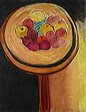 e art—it was great to see the Matisse Apples again, as my daughter and I had spent several delightful hours copying it several years ago. (Hint: nonchalantly swipe one of the folding stools and just sit down as if you belonged there. Confine your art materials to colored pencils and paper and no one will bother you.) Also, I really enjoyed seeing the Giorgio de Chirico Eventuality of Destiny. I asked about this painting over 17 years ago, was told it was in storage, and it’s
 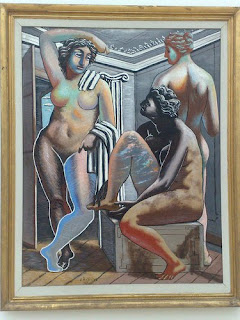 been moldering there ever since, to the best of my knowledge. It’s a very interesting work with figures who look like Greek statues, dancing like the Graces, but far out of proportion to the room they’re in, with the ceiling closing in on them. I’m still thinking about that image. I’m not sure it’s entirely serious, although with that ponderous title De Chirico might not have actually been joking, either.
I particularly enjoyed seeing the collection of Joseph Cornell’s boxes. These works resemble the little personal shrines you see in Japan, and I think they do a very good job of focusing your attention down on the artist’s personal iconography and drawing you into an intimate visual experience. There are quite a few of them, and seeing them all together helps somewhat to explain each one. I’m anxious to go back and spend some time just focused on that selection. There’s also some nice Legers, albeit mostly smaller works. The place to see Leger is definitely the Pompidou Center in Paris, where it’s a breathtaking experience to see the Legers in the context of a building that looks so much like them.
After about two hours of wandering (45 minutes of it futilely), we ended up with dinner at the eponymous Renzo Piano restaurant. Delicious, but definitely in the cute food category. It does seem to be a trend that the more you pay for the meal, the less food you get. My companion’s face really fell when the “red plum upside down cake” arrived and it was the size of a spool of thread. All very delicious, but I wasn’t worried about the scale the next morning.
Anyway, it’s a fine collection and well worth a look see. But clutch your map, and, oh yeah, wear comfortable shoes.
Photographs of the outside of the building have produced some spectacular images of line and negative space, but from street level, gee, I dunno—looks like an industrial park building to me. Inside, I really really wanted to see the collection, much of which has been “in the basement” for years. We wandered in the door, asked for information, and were told to start at the third floor and work our way down. Getting to the third floor, that was the trick! Asked a security guard, took the elevator he pointed at, ended up on the third floor in the restaurant/drinks area. Can’t get there from here—back downstairs, long walk to another elevator, not the right one either. Another security guard, another elevator. I felt like Pac man in the maze, and needed to sit down even before, on the third try, we finally reached the galleries.
The galleries themselves strike me as being exceptionally well lighted, and glare and shadow free. Although there was quite a crowd, it was easy to move around the rooms, and there’s plenty of space between paintings to take a good look without having to listen to someone else’s ipod. However, I wish my companion’s name had been Ariadne, because I needed a large ball of string to find my way in and out of each gallery, and make any sort of efficient progression from room to room, out of one level and down to the next. Maybe we’re supposed to feel the delight of discovery and surprise, but I like some sort of sensible path, myself. I don’t want to be aware of the route, or need to pay close attention, when I am trying to focus on a display. So, as an interior space, while Piano’s design may work well for the art, it doesn’t work all that well for the humans who want to use it, and thus fails my own personal architecture test.
As to th
 e art—it was great to see the Matisse Apples again, as my daughter and I had spent several delightful hours copying it several years ago. (Hint: nonchalantly swipe one of the folding stools and just sit down as if you belonged there. Confine your art materials to colored pencils and paper and no one will bother you.) Also, I really enjoyed seeing the Giorgio de Chirico Eventuality of Destiny. I asked about this painting over 17 years ago, was told it was in storage, and it’s
  been moldering there ever since, to the best of my knowledge. It’s a very interesting work with figures who look like Greek statues, dancing like the Graces, but far out of proportion to the room they’re in, with the ceiling closing in on them. I’m still thinking about that image. I’m not sure it’s entirely serious, although with that ponderous title De Chirico might not have actually been joking, either.
I particularly enjoyed seeing the collection of Joseph Cornell’s boxes. These works resemble the little personal shrines you see in Japan, and I think they do a very good job of focusing your attention down on the artist’s personal iconography and drawing you into an intimate visual experience. There are quite a few of them, and seeing them all together helps somewhat to explain each one. I’m anxious to go back and spend some time just focused on that selection. There’s also some nice Legers, albeit mostly smaller works. The place to see Leger is definitely the Pompidou Center in Paris, where it’s a breathtaking experience to see the Legers in the context of a building that looks so much like them.
After about two hours of wandering (45 minutes of it futilely), we ended up with dinner at the eponymous Renzo Piano restaurant. Delicious, but definitely in the cute food category. It does seem to be a trend that the more you pay for the meal, the less food you get. My companion’s face really fell when the “red plum upside down cake” arrived and it was the size of a spool of thread. All very delicious, but I wasn’t worried about the scale the next morning.
Anyway, it’s a fine collection and well worth a look see. But clutch your map, and, oh yeah, wear comfortable shoes.
Wednesday, July 29, 2009
Personal stimulus plan for the arts
If everyone who ever has ever thought about writing a book or majored in English would subscribe to one literary journal, those tiny and usually struggling publications would see their circulations skyrocket. If everyone whose child has ever taken dance lessons would attend one dance performance a month (hey, once a quarter), many dance troupes would find they could actually afford to continue. If everyone who ever enjoyed acting in a high school play would attend three or four experimental theater events or independent movie festivals, these projects wouldn’t have to function in borrowed spaces and decrepit venues.
My point is, all of these things are the training and proving grounds for the arts. If we want to enjoy innovative and creative arts, there has to be an audience that supports them. Plenty of us are interested in being seen ourselves. Couldn’t we benefit by seeing what others are doing? Wouldn’t it just be fun to get our car out of the usual ruts and drive somewhere different?
Not only do the arts desperately need support, but artists also crave feedback. Personally, I have really enjoyed meeting writers at bookstore signings. Hearing Robert Coles speak years ago, I’m still thinking over some of the things he said, and it was a great thrill to meet him in person, to find out how soft spoken and shy he appeared. That kind of opportunity has really diminished in the last year or so, and why? Because publishers are reluctant to take on the expense of sending an author on a book tour where she may find herself sitting alone at a table for hours. People just don’t come, unless the writer is a blockbuster. If we do read a good short story in a lit journal, would it kill us to drop a line to the author? Ever considered that it might be helpful to tell a director of that play what staging you thought worked? Sure, bestselling novelists get more mail than they can handle, but the mid-tier artist often gets very little feedback. At its best, art communicates; it would be nice if the conversation were two-way.
Most of us have cut back on eating out, and perhaps traded first run movies for discs from Netflix. If there’s any room for a tiny bit more belt tightening, perhaps those savings could be put into supporting the small arts production of your choice. I’m currently trying to pick up at least one literary journal per month at the local bookstore, with an eye to finding one or two to subscribe to that I really enjoy and will actually read. Artists and people who would like to see a vibrant arts scene might well consider the wisdom of Rabbi Hillel, “If I am not for myself, who will be for me? But if I am only for myself, then what am I? If not now, when?”
Seen any good dance performances lately?
My point is, all of these things are the training and proving grounds for the arts. If we want to enjoy innovative and creative arts, there has to be an audience that supports them. Plenty of us are interested in being seen ourselves. Couldn’t we benefit by seeing what others are doing? Wouldn’t it just be fun to get our car out of the usual ruts and drive somewhere different?
Not only do the arts desperately need support, but artists also crave feedback. Personally, I have really enjoyed meeting writers at bookstore signings. Hearing Robert Coles speak years ago, I’m still thinking over some of the things he said, and it was a great thrill to meet him in person, to find out how soft spoken and shy he appeared. That kind of opportunity has really diminished in the last year or so, and why? Because publishers are reluctant to take on the expense of sending an author on a book tour where she may find herself sitting alone at a table for hours. People just don’t come, unless the writer is a blockbuster. If we do read a good short story in a lit journal, would it kill us to drop a line to the author? Ever considered that it might be helpful to tell a director of that play what staging you thought worked? Sure, bestselling novelists get more mail than they can handle, but the mid-tier artist often gets very little feedback. At its best, art communicates; it would be nice if the conversation were two-way.
Most of us have cut back on eating out, and perhaps traded first run movies for discs from Netflix. If there’s any room for a tiny bit more belt tightening, perhaps those savings could be put into supporting the small arts production of your choice. I’m currently trying to pick up at least one literary journal per month at the local bookstore, with an eye to finding one or two to subscribe to that I really enjoy and will actually read. Artists and people who would like to see a vibrant arts scene might well consider the wisdom of Rabbi Hillel, “If I am not for myself, who will be for me? But if I am only for myself, then what am I? If not now, when?”
Seen any good dance performances lately?
Wednesday, July 8, 2009
Why do kids quit doing art?
My daughter played startlingly beautiful improvisations when younger, but as her music study went on she began to focus more and more on her lesson material and on learning to play her instrument with increasing expertise. The improvisation dropped off due to no time and a lot of demanding skills acquisition. I worried about the loss of joy, especially during those practice times when I heard her growl in frustration.
Many children produce wonderful images and sounds early on. Think of the freshness of much child-written poetry, melody, or art. Picasso and others often spoke about the need to remain as a child when approaching art. The challenge is to mature into an understanding of what you’re doing, while still maintaining freshness and innovation. Not easy. But also, without training, most artists will eventually get frustrated with their lack of ability to produce the skillful and sophisticated works rattling around in their heads. Perhaps this is why, without serious training in drawing skills, so many kids give up drawing at about age 10 or 11--they start to know that there's something better out there, but need the training to access it.
The age when children decide to give up in frustration is also the age when schools start to regard all the arts as a nice supplement, if they can afford the time and the money (NOT!). Sure, a huge after-school industry in arts instruction has developed, but only for the parents who seek it out and can afford it. We are now a nation who can’t draw stick figures, pick out a simple melody, or even dance. Yet we stop offering any instruction at just the age when children might make some real headway in learning the skills, and then be able to apply those skills to their own creative inspirations.
Real music composing, at least classical, is a very complex endeavor, requiring expertise with a variety of instruments, a historical vocabulary, and much theory. If the spark is truly there, and opportunities and encouragement are offered, I think the young person will return to their art interests with a vengeance. Mine has.
Homeschooling and my own interests have provided my daughter with a veritable flood of arts instruction and activities. Thanks to the greater interest in homeschooling, there’s a cornucopia of self-instructional materials available. If you want to be overwhelmed with what’s available to play with, check out the Rainbow Resources catalog. It’s a treasure trove for homeschoolers, after-schoolers, and even adults. Self-instruction programs are a lot cheaper than many classes, portable, adaptable to your time schedule, and teach self-reliance and how to be a life long learner.
And if you just want to learn to draw a (much better) stick figure, check out Mark Kistler’s books. Talent may be a spark within, but anyone can learn the skills.
Many children produce wonderful images and sounds early on. Think of the freshness of much child-written poetry, melody, or art. Picasso and others often spoke about the need to remain as a child when approaching art. The challenge is to mature into an understanding of what you’re doing, while still maintaining freshness and innovation. Not easy. But also, without training, most artists will eventually get frustrated with their lack of ability to produce the skillful and sophisticated works rattling around in their heads. Perhaps this is why, without serious training in drawing skills, so many kids give up drawing at about age 10 or 11--they start to know that there's something better out there, but need the training to access it.
The age when children decide to give up in frustration is also the age when schools start to regard all the arts as a nice supplement, if they can afford the time and the money (NOT!). Sure, a huge after-school industry in arts instruction has developed, but only for the parents who seek it out and can afford it. We are now a nation who can’t draw stick figures, pick out a simple melody, or even dance. Yet we stop offering any instruction at just the age when children might make some real headway in learning the skills, and then be able to apply those skills to their own creative inspirations.
Real music composing, at least classical, is a very complex endeavor, requiring expertise with a variety of instruments, a historical vocabulary, and much theory. If the spark is truly there, and opportunities and encouragement are offered, I think the young person will return to their art interests with a vengeance. Mine has.
Homeschooling and my own interests have provided my daughter with a veritable flood of arts instruction and activities. Thanks to the greater interest in homeschooling, there’s a cornucopia of self-instructional materials available. If you want to be overwhelmed with what’s available to play with, check out the Rainbow Resources catalog. It’s a treasure trove for homeschoolers, after-schoolers, and even adults. Self-instruction programs are a lot cheaper than many classes, portable, adaptable to your time schedule, and teach self-reliance and how to be a life long learner.
And if you just want to learn to draw a (much better) stick figure, check out Mark Kistler’s books. Talent may be a spark within, but anyone can learn the skills.
Subscribe to:
Posts (Atom)